
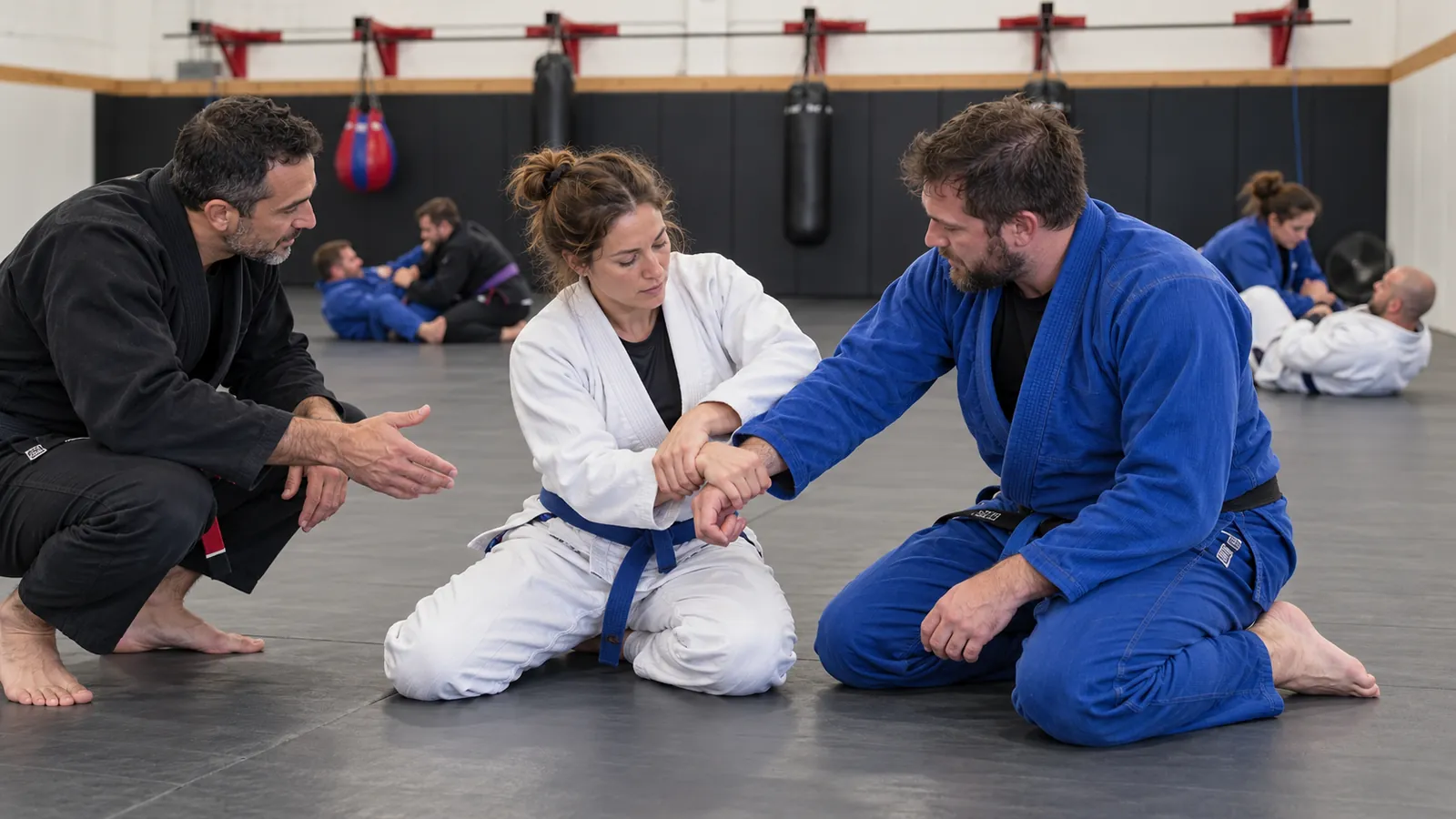
The best-designed ones can. In a Canadian randomised trial published in 2015, first-year university women assigned to a 12-hour resistance program had a 5.2% risk of completed rape over the next year, against 9.8% for women given brochures. That program was not a martial art: it combined risk assessment, verbal resistance and physical self-defence, so this post also covers what Brazilian Jiu-Jitsu can and cannot add.
What did Canada's self-defence trial find?
The trial, led by Charlene Senn, a psychology professor at the University of Windsor, and published in the New England Journal of Medicine in 2015, enrolled 893 first-year women aged 17 to 24 at three Canadian universities. Of these, 451 were randomly assigned to a program called Enhanced Assess, Acknowledge, Act (EAAA), and 442 to a session with brochures on sexual assault, then common university practice.
EAAA ran as four 3-hour units for small groups of women, led by two female facilitators: Assess (judging risk in situations with men they knew), Acknowledge (recognising danger quickly and overcoming the emotional barriers to acting), Act (verbal and physical resistance) and a unit on relationships and sexuality.
Over the following year, the risk of completed rape was 5.2% in the program group and 9.8% in the brochure group, a relative reduction of 46%. The risk of attempted rape was 3.4% against 9.3%.
A 2017 paper followed 370 of the women for two years. The effect on attempted rape held, at 4.9% against 13.5%. The gap in completed rape narrowed to 8.1% against 11.8%, no longer statistically significant, and the authors suggest a second-year booster may be needed.
Responsibility for assault lies with the person who commits it. The program itself teaches that perpetrators are entirely responsible for their crimes. Programs aimed at women can seem to put the burden of prevention on them, and the researchers answer that criticism directly. Jocelyn Hollander, whose study is below, writes: “The responsibility for violence lies with perpetrators, and women should not be expected to prevent it, nor blamed if they do not or cannot do so.”
What else does the research show?
Two further studies point the same way, but neither was randomised: both compared women who took a program with women who did not.
| Study | Design | Who took part | What it found |
|---|---|---|---|
| Senn et al., 2015 | Randomised trial, one year | 893 first-year women, three Canadian universities | Completed rape 5.2% vs 9.8%; attempted rape 3.4% vs 9.3% |
| Senn et al., 2017 | Same trial, two years | 370 of the same women | Attempted rape 4.9% vs 13.5%; completed rape 8.1% vs 11.8%, not statistically significant |
| Senn et al., 2023 | Not randomised, six months, run by the universities | 535 women students aged 17 to 40, five Canadian universities | Completed rape 57.3% lower than in students who signed up but did not attend; attempted rape drop not significant |
| Hollander, 2014 | Not randomised, one year | 183 women at a US university, 75 of them in a 30-hour feminist self-defence class | Any sexual victimisation 12.0% vs 30.6%; completed rape none vs 2.8% |
Hollander's study was small, and after adjusting for differences between the groups the gap fell just short of statistical significance. The 2023 study suggests the program still works when universities run it themselves, with older and graduate students included.
What did the studies not test?
- Martial arts. Every program above was a purpose-built course about sexual assault. We know of no study testing whether BJJ training lowers the risk of sexual assault.
- Women outside university. The trial's authors say they do not know whether it would work as well for young women who do not attend university.
- Boyfriends. The program centred on acquaintances and dates, and its authors suggest it may not do enough against sexual assault by boyfriends later in university, one possible reason the completed rape effect faded.
Senn's team note that male acquaintances commit the vast majority of campus sexual assaults. In Statistics Canada's 2018 survey, women sexually assaulted in the previous year by someone other than a partner were as likely to name a friend or acquaintance (44%) as a stranger or someone known only by sight (44%).
Earlier research cited by both teams links forceful verbal and physical resistance with avoiding rape and, in studies Hollander cites, with no increase in physical injury. But women are least likely to use these strategies against men they know, which is why two of the program's four units went on recognising risk and overcoming the hesitation to act.
What can BJJ add to a woman's self-defence?
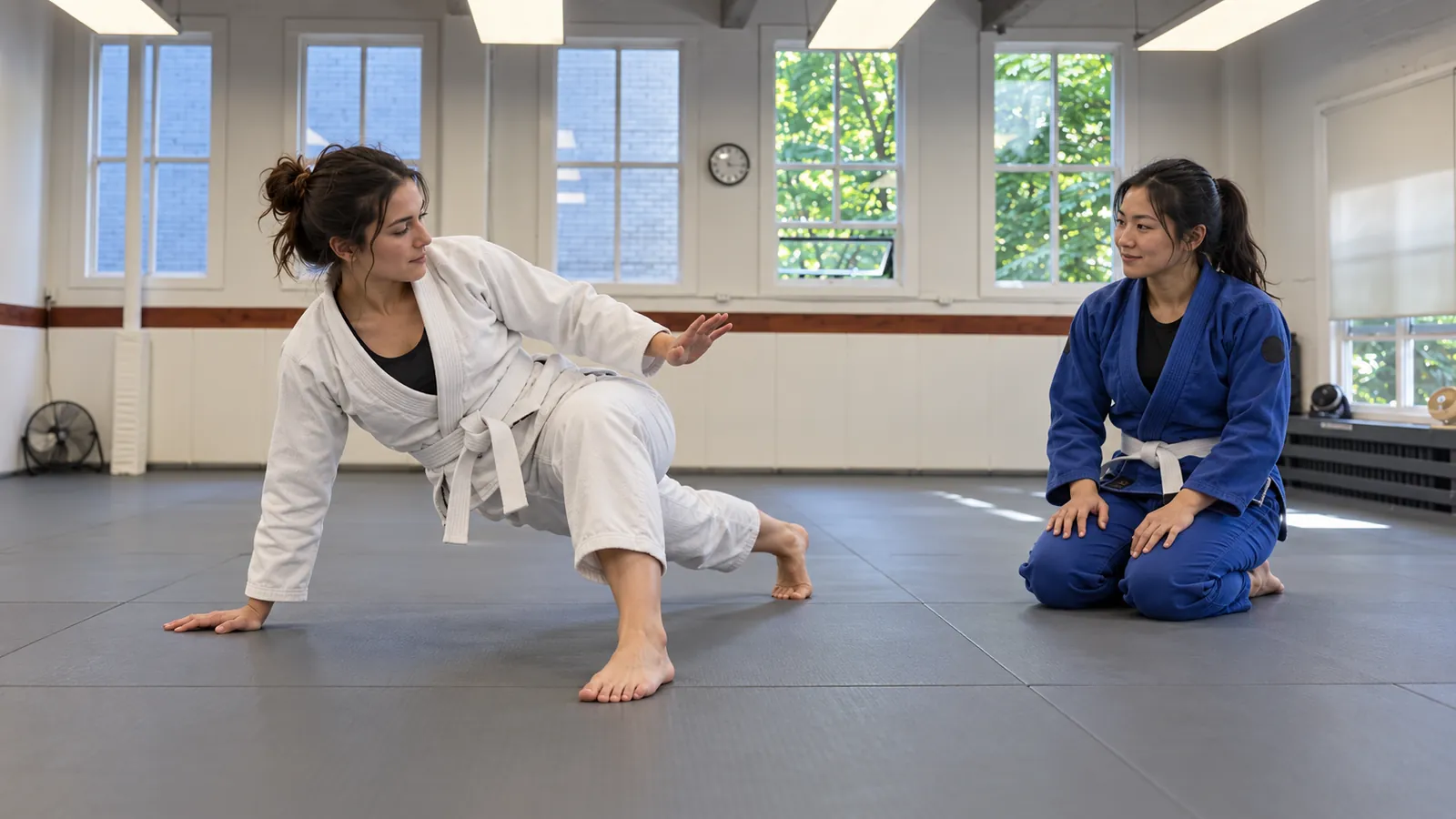
The physical part, practised for real. Brazilian Jiu-Jitsu is built on leverage, timing and position rather than strength, so a smaller, lighter person can deal with a larger, stronger one. Classes train escaping holds, getting back to your feet safely and controlling someone bigger without striking, against a partner who is genuinely resisting. That also trains staying calm and thinking clearly under pressure.
| Trial program (EAAA) | BJJ classes | |
|---|---|---|
| Judging risk with people you know | A full unit | Not a focus |
| Recognising danger and acting early | A full unit | Not a focus |
| Verbal resistance | Part of one unit | Not a focus |
| Physical self-defence | Part of one unit | Every class, against a resisting partner |
| Tested against assault outcomes | Yes, in a randomised trial | No |
BJJ gives you physical options and practice using them under pressure, but not the skill of reading a social situation or acting early with someone you know. If you are a university student, ask whether your campus runs the trial's program, now called Flip the Script with EAAA. The Canadian Institutes of Health Research reported in 2025 that it has been offered at more than 30 colleges and universities in Canada and six other countries, and that a women's centre on BC's North Shore has run it in the community.
Which martial art is best for women's self-defence?
We know of no martial art tested against assault outcomes, so this is judgement, not data. Ours is that grappling is the most direct preparation for being grabbed, held or taken down by someone bigger, and BJJ is built around that size difference. Striking adds distance and power, and many people add it later.
What should you look for in a self-defence class?
- Enough hours to matter. The programs in these studies ran for 12 to 30 hours, and the trial's authors call brief, large-group sessions ineffective.
- Risk and verbal skills as well as physical ones, including scenarios with people you know. In Statistics Canada's 2018 survey, 32% of women, against 13% of men, had faced unwanted sexual behaviour in public in the previous year; for women, it was most often unwanted sexual attention.
- Practice against a resisting partner, at an intensity you choose.
- Partners close to your size while you learn, and the right to stop at any moment.
- Coaching that never suggests anyone is to blame for being assaulted.
- A setting you are comfortable in, women-only or mixed. The trial program was women-only.
What is training like at our academies?
Every adult class at our three academies, in Downtown Vancouver, Langley and Maple Ridge, is open to women, and no experience is needed. Complete beginners start in the Foundations class, taught at all three, where the pace is controlled and the coaching is closer.
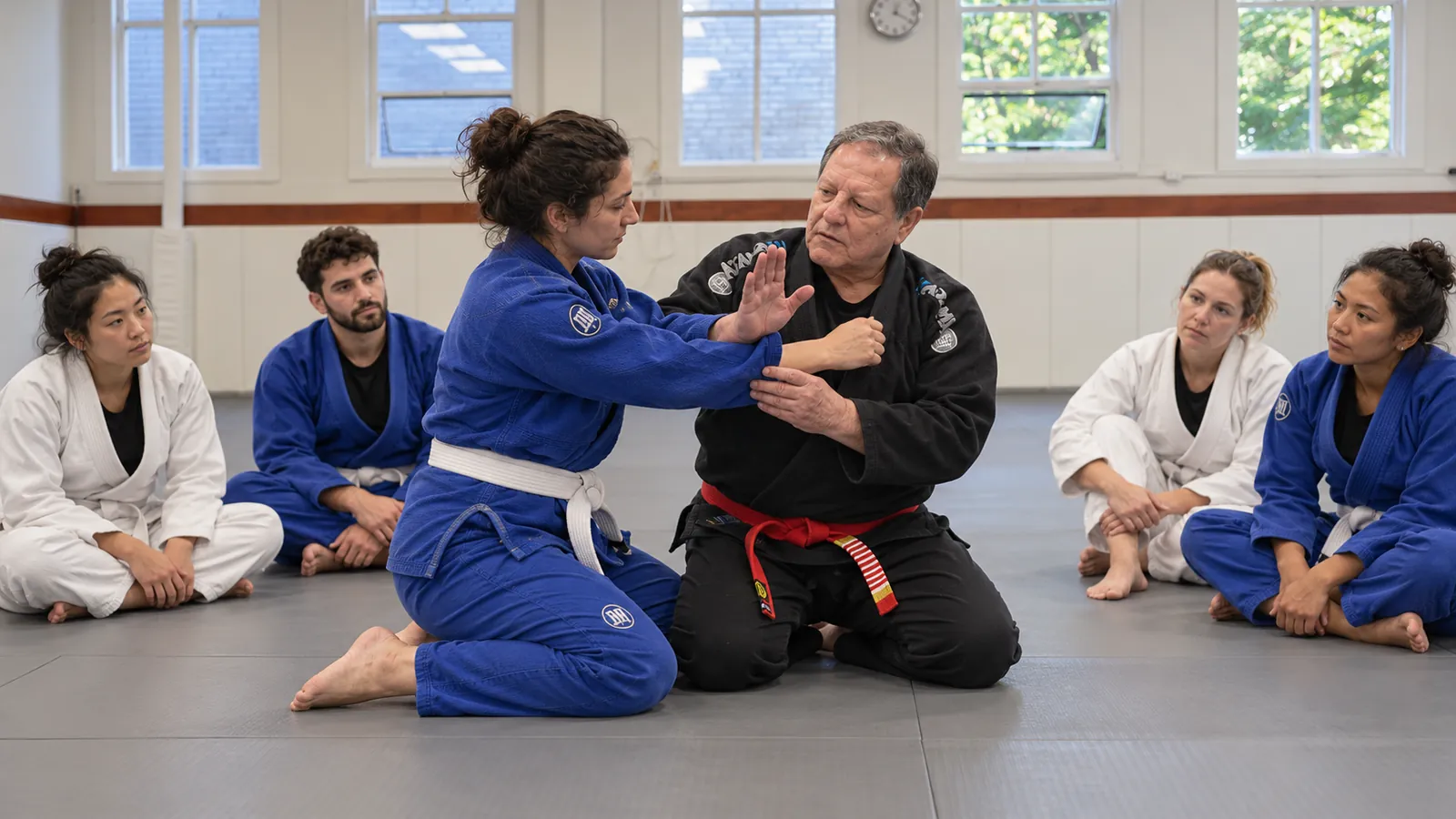
Classes start with a warm-up, then your coach shows a technique and you practise it with one partner, step by step. Later comes controlled sparring, called rolling, against someone resisting. You can tap to stop at any moment and ask your coach to pair you with someone closer to your size. We can lend you a gi for your trial, and we train adults of every age and fitness level. The $29 introductory two-week trial for new students is the simplest way to see whether the room suits you.
Common questions
Well-designed programs can. In a Canadian randomised trial of 893 first-year university women, published in 2015, a 12-hour resistance program cut the one-year risk of completed rape from 9.8% to 5.2%, compared with brochures. At two years, the effect on attempted rape held, but the completed rape gap was no longer statistically significant. We know of no martial art tested this way.
It is a strong physical foundation. BJJ trains escaping holds, getting back to your feet and controlling a bigger person, against a resisting partner, every class. No study we know of has tested it as a way to prevent sexual assault, and it does not focus on the risk assessment and verbal skills the Canadian trial program taught, so the two complement each other.
It can give her real options. BJJ uses leverage, timing and position so a smaller person can deal with a larger one, and practice with bigger partners builds escapes and calm under pressure. Technique narrows a size gap without erasing it, no art guarantees the outcome of a real assault, and responsibility always lies with the person who commits it.
They can be, if the course is substantial. The programs in a Canadian trial and a US university study ran for 12 to 30 hours and combined recognising risk with verbal and physical skills, while brief, large-group sessions have a weak record. BJJ adds physical skill and calm under pressure, and works best alongside the awareness side.
In mixed classes you will partner with both women and men. You can ask a coach to pair you with someone closer to your size, and tap to stop at any moment. Training with bigger partners, at a pace you control, is also how self-defence skills are built. Every adult class at our three academies is open to women.
Want to try it on the mat?
Two weeks of unlimited classes for $29. No experience needed.
Sources
- Senn CY et al., “Efficacy of a Sexual Assault Resistance Program for University Women”, New England Journal of Medicine, 2015
- Senn CY et al., “Secondary and 2-Year Outcomes of a Sexual Assault Resistance Program for University Women”, Psychology of Women Quarterly, 2017
- Senn CY et al., “Testing the effectiveness of a sexual assault resistance programme in ‘real-world’ implementation”, European Journal of Psychotraumatology, 2023
- Hollander JA, “Does Self-Defense Training Prevent Sexual Violence Against Women?”, Violence Against Women, 2014
- Statistics Canada, “Gender-based violence and unwanted sexual behaviour in Canada, 2018: Initial findings from the Survey of Safety in Public and Private Spaces”, The Daily, 2019
- Canadian Institutes of Health Research, “Flipping the script to recognize and stop sexual violence against young women”, Research impact, 2025