
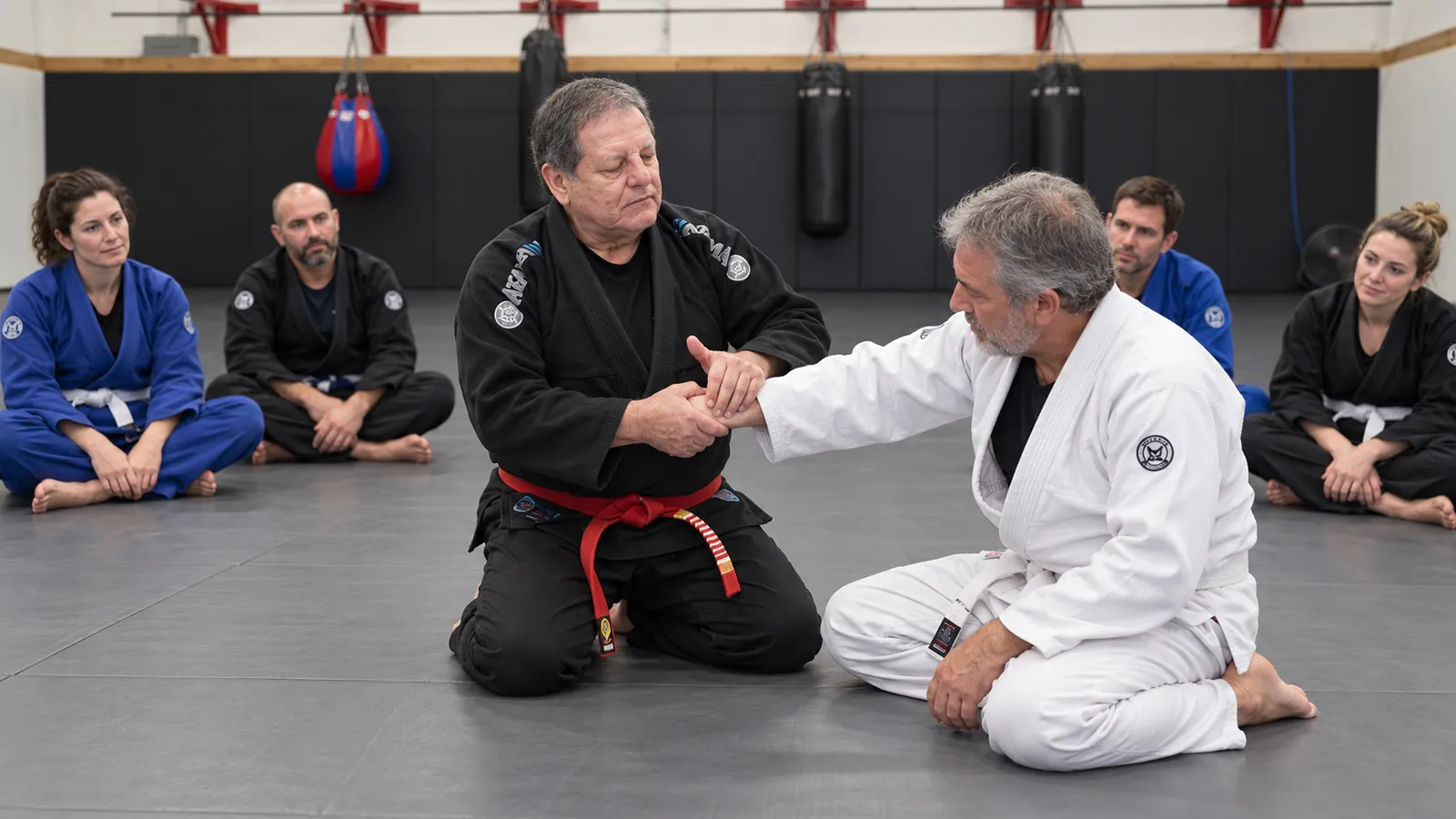
No. There is no upper age limit for starting Brazilian Jiu-Jitsu: the International Brazilian Jiu-Jitsu Federation (IBJJF) lists the white belt as open to “any age”, and its masters divisions run up to 61 and over. In a survey of 1,140 athletes averaging about 32 years old, older age was linked to slightly more injuries, so what changes after 30, 40, 50 or 60 is how you train (more recovery, controlled sparring, tapping early), not whether you can learn.
Is there an age limit for starting BJJ?
Only at the young end. Under the IBJJF's graduation rules, the adult belts above white have minimum ages (16 for blue, for example) but no maximum, so a 55-year-old beginner starts at the same white belt as a 25-year-old. Our adult classes are open to anyone aged 14 and up. Many of our students started in their 40s or 50s, and some are past 60.
What are masters divisions in BJJ?
In competition, “master” is an age category, not a rank. Under IBJJF rules you become a master in the year you turn 30:
| Division | Age in the competition year |
|---|---|
| Adult | 18 to 29 |
| Master 1 | 30 to 35 |
| Master 2 | 36 to 40 |
| Master 3 | 41 to 45 |
| Master 4 | 46 to 50 |
| Master 5 | 51 to 55 |
| Master 6 | 56 to 60 |
| Master 7 | 61 and over |
Age is counted by birth year, so someone born in 1981 counts as 45 for all of 2026, which places them in Master 3. As a title, “master” means something else: the IBJJF calls coral belts “Masters' belts” and the red belt a “Grand Master's Belt”. Competing is optional, and the research below suggests it carries risk of its own.
Do older beginners get injured more?
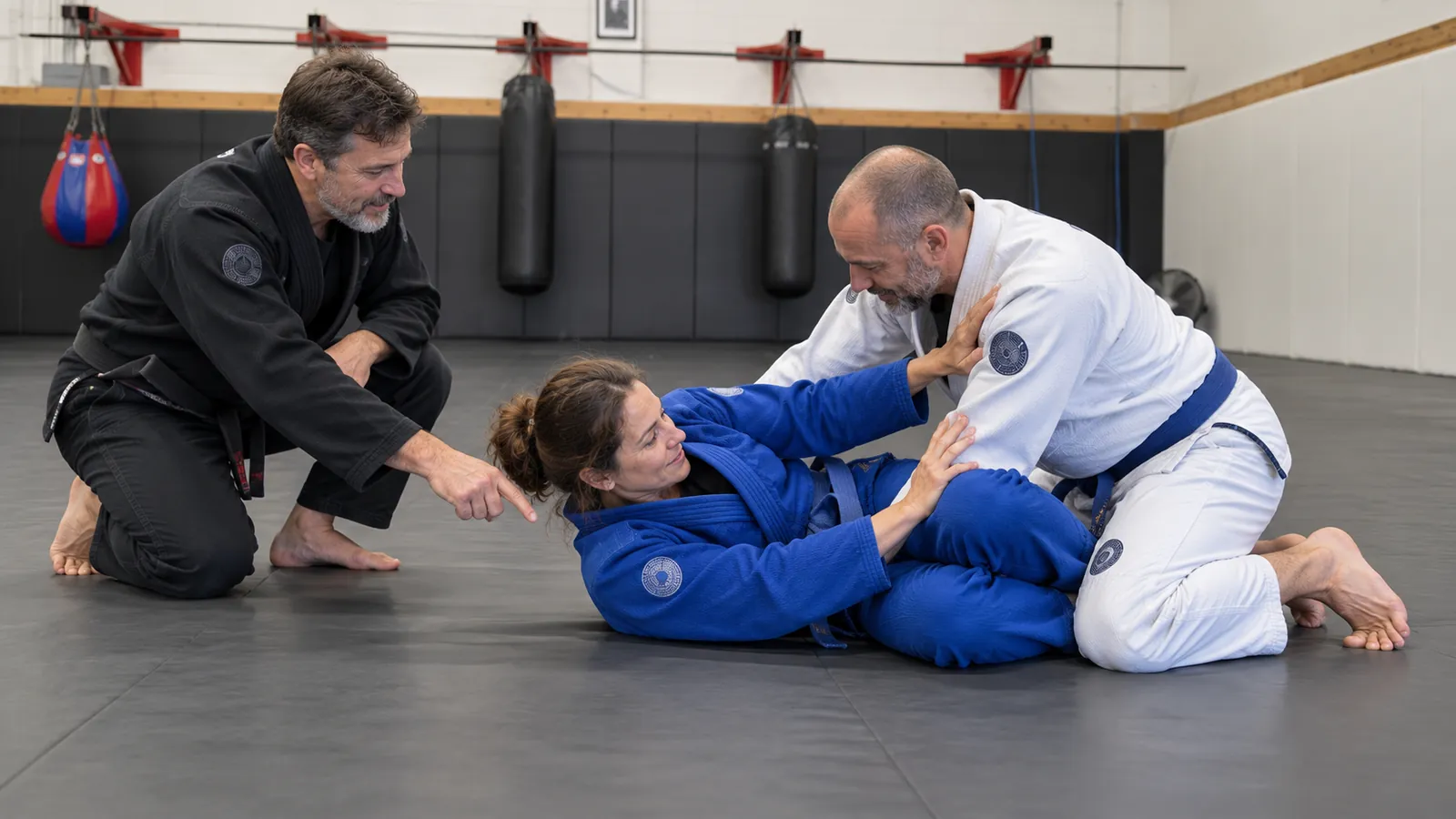
Slightly, though the evidence is about older practitioners in general rather than beginners. A survey of 1,140 athletes from 62 countries, published in 2021, found older age was a significant risk factor for injury over three years, but the injured were on average only about two years older than the uninjured (32.5 against 30.1).
Age, sex, height and weight together explained just 2% of the variation in injuries. Competing mattered too: regular competitors averaged 1.01 injuries over the three years, against 0.76 for those who did not compete.
Injury was common overall: over the three years, 69% reported at least one that kept them off the mat for two weeks or more. Most happened in sparring (77.6%), and submissions (29.7%) and takedowns (26.4%) caused more than half.
A smaller 2017 study of 193 practitioners in Campo Grande, Brazil, pointed the same way, counting any pain or dysfunction that changed how someone trained:
| Group | Median age | Median time training | Injuries per person |
|---|---|---|---|
| Adolescents (under 18) | 15 | 12 months | 0.59 |
| Adults (18 to 30) | 25 | 24 months | 1.37 |
| Masters (over 30) | 35 | 36 months | 1.94 |
The masters were also the heaviest and had trained longest, which the authors suggest probably plays a part. Both studies relied on people remembering past injuries, and neither says much about starting at 55: the larger one's average respondent was about 32, and the smaller one's masters had a median age of 35.
The honest summary: age nudges the risk up a little, and most of the risk sits in sparring, which you control. The larger study's authors recommend safer sparring, tapping early and treating rounds as learning rather than winning.
Starting BJJ at 30 or 40: what changes?
Less than you might fear. The bigger change is usually the rest of your life: with work and family setting your timetable, two classes every week will take you further than four one week and none the next.
Old injuries deserve attention. The knee (27.1% of injuries) and shoulder (14.6%) were the most commonly hurt in the 2021 survey, so tell the coach about any history with either. The other adjustment is ego: you will roll with people half your age who have trained for years. Tap early, reset and learn from it.
Starting BJJ at 50, 60 or older: what changes?
BJJ is a contact sport, so speak to your doctor first if you have a heart condition, joint replacement, osteoporosis or a recent injury. Be clear, too, about the gap in the evidence: the studies above mostly describe people under 40, so nobody can give you a precise injury rate for a beginner of 60. That is a reason for a careful pace, not for staying off the mat.
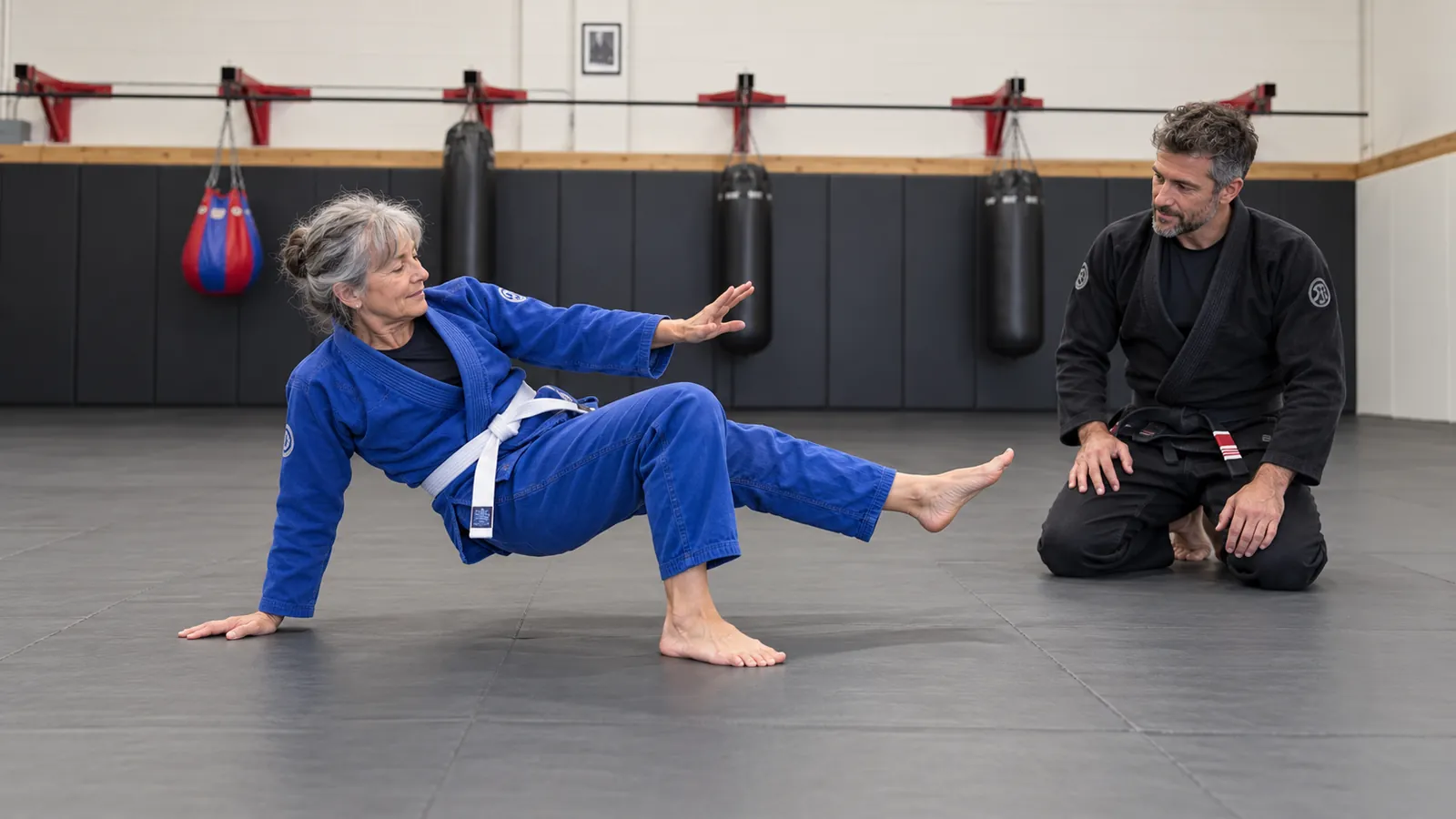
Balance is the other real difference. A class means going down to the mat and getting back up again and again, and getting back to your feet safely is part of what our classes teach. Canada's 24-Hour Movement Guidelines for adults aged 65 and older recommend “physical activities that challenge balance”, which describes much of a jiu-jitsu class.
Take standing work slowly: takedowns caused about a quarter of the injuries in the 2021 survey.
How often should you train if you start later?
Twice a week is the right place to start: enough for technique to carry over between classes, with time to recover in between. Add a third once two feel comfortable, and build up over months rather than weeks.
Canada's 24-Hour Movement Guidelines, from the Canadian Society for Exercise Physiology, ask adults of every age for at least 150 minutes a week of moderate to vigorous activity, and muscle strengthening at least twice a week. A class touches both, along with balance: hard breathing in live rounds, whole-body pushing and pulling, and constant work to keep your base. Two classes may not reach 150 minutes alone, because part of each class is spent watching a technique, so keep walking, cycling or whatever else you already do.
How long will progress take if you start later?
Belts do not care when you started. Under the IBJJF's graduation system, adults and masters face the same minimum times: none at white belt, two years at blue, a year and a half at purple and a year at brown. What varies is how often you can train. For an adult training two or three times a week, our guides estimate about two years to blue belt and 8 to 12 years or more to black belt, so someone who starts at 50 and trains steadily could reach black belt in their late 50s or early 60s.
What did a 70-year-old grandmaster say about age?
Grand Master Marcus Soares is Canada's only 9th-degree red belt, and in May 2026 the Langley Advance Times reported that, at 70, he was still teaching seven days a week. He did not start late: an uncle introduced him to Carlson Gracie at 13, and he began training in 1970.
The late start in his story was a different one. At 40, not yet speaking English, he moved to Canada determined to establish the art he loved. “I came to Canada with $2,000 in my pocket, and I didn't speak English,” he told the paper. Asked why he still teaches, he talked about his grandfather, who “got old so fast” after retiring. “You lose purpose in life,” he said.
How do you start BJJ safely after 40?
At all three of our academies (Downtown Vancouver, Langley and Maple Ridge), beginners start in the Foundations class, where the pace is controlled and the coaching is closer.
- Tell the coach about any injury before your first class.
- Ask to be paired with someone close to your size.
- Tap early. You can tap to stop at any moment.
The easiest way in is the $29 introductory two-week trial for new students, and we can lend you a gi for it. Adult memberships, for ages 14 and up, start from $169 a month and cover all three academies.
If you already watch your child train, you would not be the first to cross over. One parent at our Vancouver academy wrote: “I started after watching my son train and I haven't stopped since.”
Adult BJJ and beginner classes
Common questions
No. In the year you turn 40 you compete as a Master 2 under IBJJF rules, and masters divisions run up to 61 and over. What changes is how you train: two classes a week, controlled sparring, early tapping and partners close to your size. The IBJJF's minimum time at each belt is the same for adults and masters.
No. Adult BJJ belts above white have minimum ages but no maximum, and IBJJF competition divisions run up to 61 and over. It is a contact sport, so speak to your doctor first if you have a heart condition, joint replacement, osteoporosis or a recent injury. Then start in a beginners class and build up slowly.
Yes. The white belt is open to any age, and our own students include adults in their 60s and beyond. Speak to your doctor first if you have a heart condition, joint replacement, osteoporosis or a recent injury. Injury research mostly covers people under 40, so start at a careful pace with sensible partners.
In IBJJF competition, masters starts at 30. Master 1 covers ages 30 to 35, followed by five-year divisions from Master 2 (36 to 40) to Master 6 (56 to 60), and Master 7 for 61 and over. Age is counted by birth year, so you compete at the age you turn that year. Competing is optional.
It can be, at a careful pace. A class touches three things Canada's 24-Hour Movement Guidelines recommend for adults 65 and older: moderate to vigorous activity, muscle strengthening and activities that challenge balance. The trade-off is injury risk: in a survey of 1,140 athletes, older age was linked to slightly more injuries, and most happened in sparring, so keep your rounds controlled.
Want to try it on the mat?
Two weeks of unlimited classes for $29. No experience needed.
Sources
- Hinz M et al., “Injury Patterns, Risk Factors, and Return to Sport in Brazilian Jiu Jitsu: A Cross-sectional Survey of 1140 Athletes”, Orthopaedic Journal of Sports Medicine, 2021
- das Graças D et al., “Could current factors be associated with retrospective sports injuries in Brazilian jiu-jitsu? A cross-sectional study”, BMC Sports Science, Medicine and Rehabilitation, 2017
- International Brazilian Jiu-Jitsu Federation, General System of Graduation, June 2026
- Canadian Society for Exercise Physiology, “Canadian 24-Hour Movement Guidelines for Adults aged 18-64 years”
- Canadian Society for Exercise Physiology, “Canadian 24-Hour Movement Guidelines for Adults aged 65 years and older”
- Matthew Claxton, “Langley's 70-year-old jiu-jitsu grandmaster still teaches 7 days a week”, Langley Advance Times, May 2026