
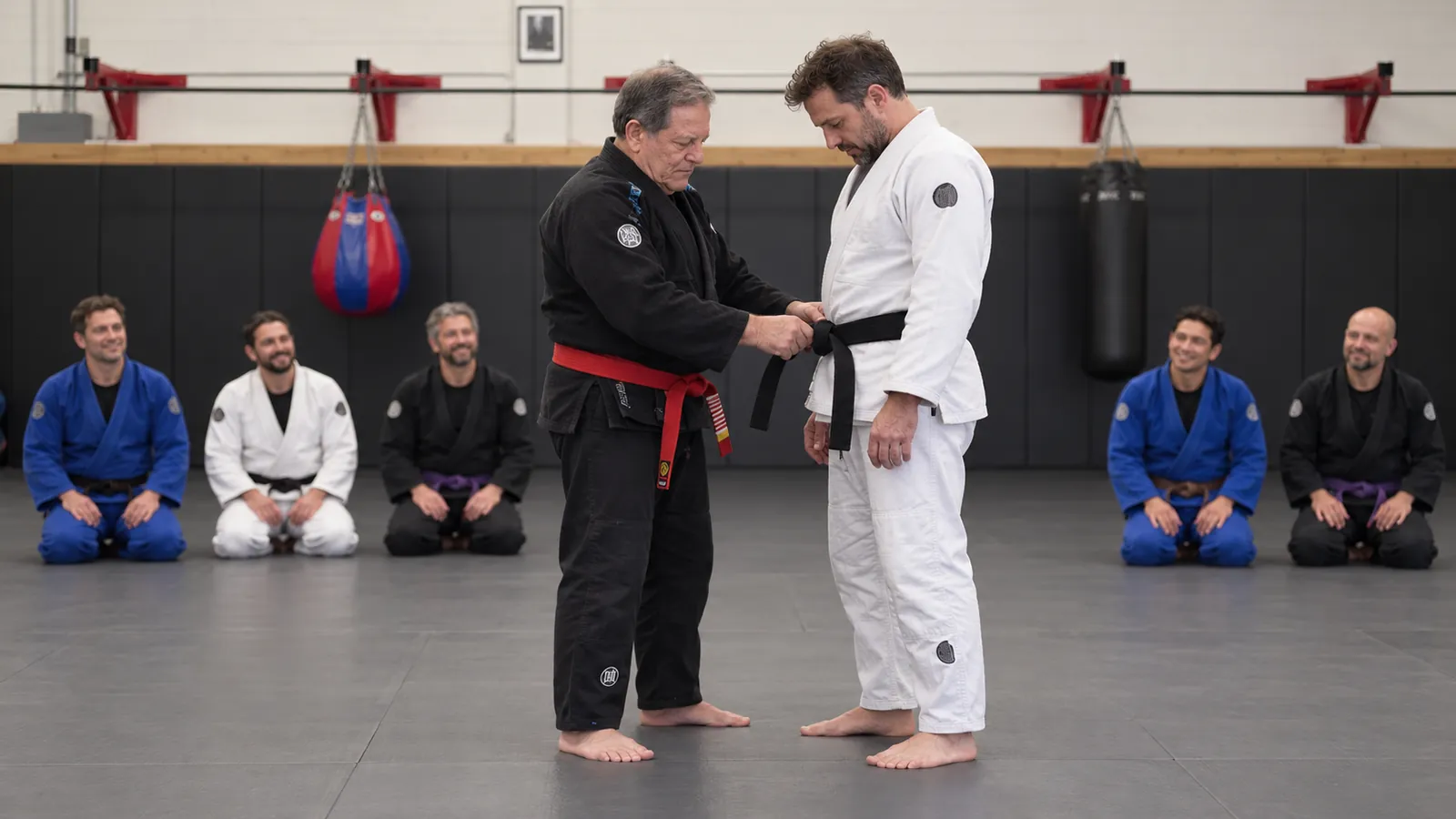
For an adult training two or three times a week, a black belt in Brazilian Jiu-Jitsu takes 8 to 12 years by our estimate. The IBJJF sets only minimums: on its standard route, four and a half years after leaving white belt, with a minimum age of 19. At our academies, under Grand Master Marcus Soares, it typically takes more than a decade.
What is the fastest you can get a black belt under IBJJF rules?
The International Brazilian Jiu-Jitsu Federation (IBJJF) publishes a General System of Graduation, which sets a minimum age for each adult belt and a minimum time to spend at each one. These are the figures in its June 2026 edition:
| Belt | Minimum age | Minimum time at this belt |
|---|---|---|
| White | Any age | None |
| Blue | 16 | 2 years |
| Purple | 16 | 1.5 years |
| Brown | 18 | 1 year |
| Black | 19, or 18 for an adult world champion at brown belt | 3 years to the 1st degree, 31 to the coral belt |
Add up the minimums at blue, purple and brown and the fastest standard route is four and a half years after leaving white belt, which has no minimum of its own. The 2026 edition added one exception: an athlete who wins the adult world title at brown belt can be promoted at 18. Everyone else waits until 19. For comparison, B.J. Penn started training at 17 and, Sherdog reported, earned his black belt from André Pederneiras after about three years, faster than today's standard route allows.
The rules also shorten or waive some minimums for adult world champions at blue, purple and brown, and for students who were registered with the federation as children or at 16 or 17. Above all, they leave the pace from white belt to black belt to the professor: the federation sets the floor, and your professor decides when you are ready.
How long does it usually take in practice?
Much longer than the minimum, for three reasons:
- White belt has no minimum, but it is not quick. Our blue-belt guide puts a blue belt at about two years for an adult training two or three times a week.
- Minimums are not targets. They mark the earliest point the federation will recognise a promotion, not the point a student should expect one.
- A decade is a long time. Injuries, new jobs, children and moves can each cost months, and ten years leaves room for all of them.
That is how four and a half years on paper becomes, by our estimate, 8 to 12 years in practice, with purple belt typically about 4 to 5 years in and brown about 6 to 8.
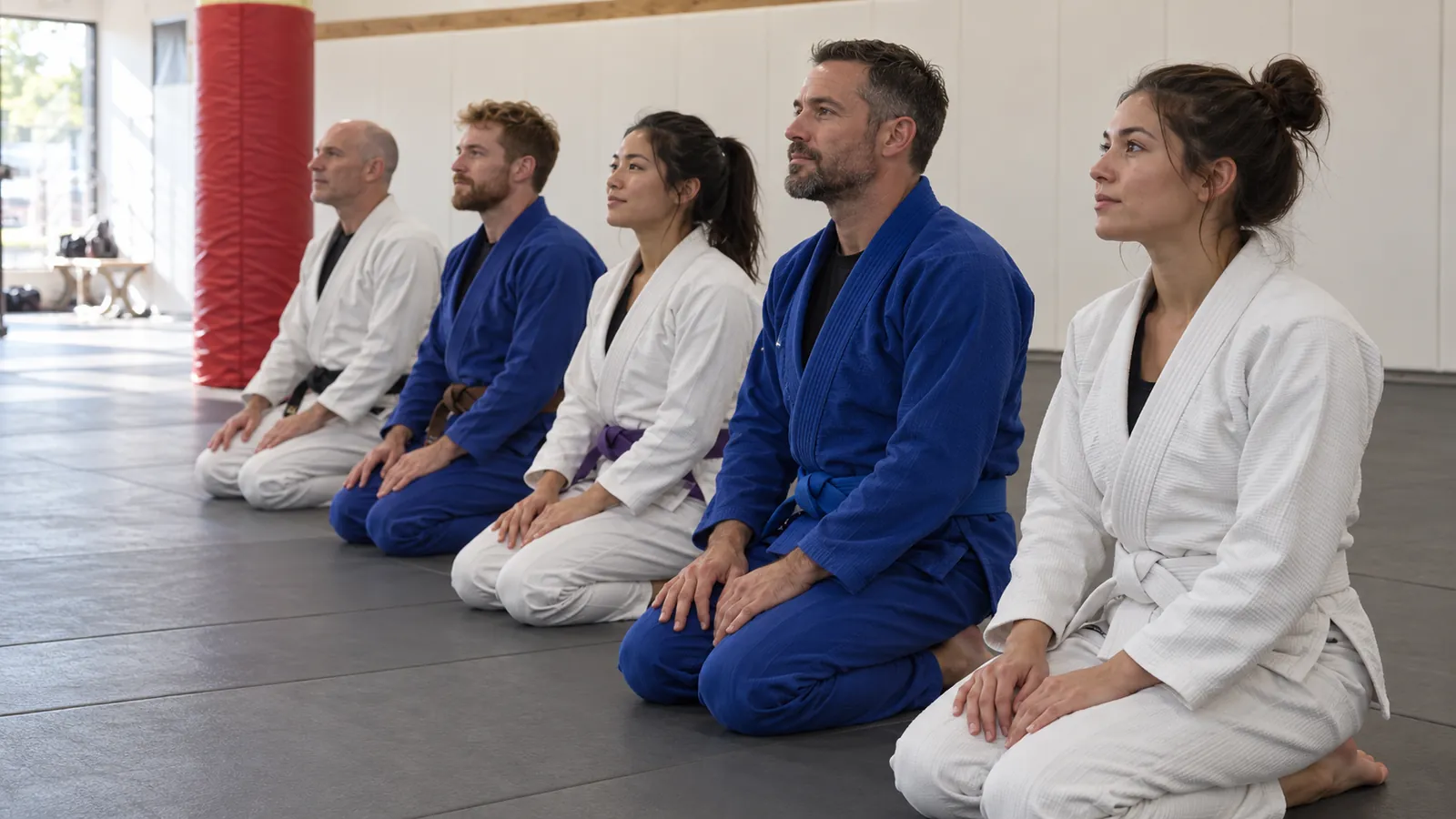
How long did it take on our black-belt roll?
Marcus Soares arrived in March 1997 as the first black belt to teach Brazilian Jiu-Jitsu in Canada. Four years later he told Grappling Magazine that, besides building a strong team, he wanted “to try to make a black belt student.” The first black belt on the academy's roll, Denis Kang, was promoted in July 2004, seven years and four months after Marcus began teaching in Canada. The roll records promotion dates, not start dates.
The roll now lists 37 black belts, the most recent being Nav Padda and Keenan Beavis in December 2025. Keenan's path is on the public record: the Langley Advance Times reported that reaching black belt took him 18 years, starting in his early teens. “It's a very long process, a very testing process,” he told the paper.
| Years | Black belts promoted | Years with no promotions |
|---|---|---|
| 2004 to 2009 | 7 | 2007 |
| 2010 to 2015 | 12 | 2012 |
| 2016 to 2021 | 11 | 2017 |
| 2022 to 2025 | 7 | 2023 and 2024 |
There were promotions in 17 of the 22 years from 2004 to 2025, never more than four in one year, and the longest gap between them was 27 months, from December 2022 to March 2025. Our adult program states the standard plainly: promotions are earned through consistent training, technical development and personal growth.
How many hours of training is a black belt?
The IBJJF sets no hours requirement, so any figure is arithmetic. Assume classes of 60 to 90 minutes and 48 weeks of training a year, allowing for holidays and illness:
| Classes a week | Classes a year | Hours a year | Hours over 10 years |
|---|---|---|---|
| Two | 96 | 96 to 144 | 960 to 1,440 |
| Three | 144 | 144 to 216 | 1,440 to 2,160 |
| Four | 192 | 192 to 288 | 1,920 to 2,880 |
Over our estimated 8 to 12 years at two or three classes a week, that comes to roughly 800 to 1,700 classes, or about 800 to 2,600 hours on the mat. The hours cannot be crammed, either. Someone training every day still faces the same minimum time at each belt.
What changes how long it takes?
- How often and how steadily you train. Two or three classes a week, kept up for years, is where progress happens. Once a week mostly maintains what you have.
- Starting as a child. An early start cannot skip the age rules (16 for blue, 19 for black), but it can shorten the wait later: kids' belts convert to adult ones in the year a student turns 16, and the IBJJF cuts some adult minimums for students whose kids' belts were registered with it.
- A grappling background. Judo or wrestling experience can shorten white belt, which has no minimum time, but from blue belt onwards a judoka or wrestler faces the same minimum periods as anyone else.
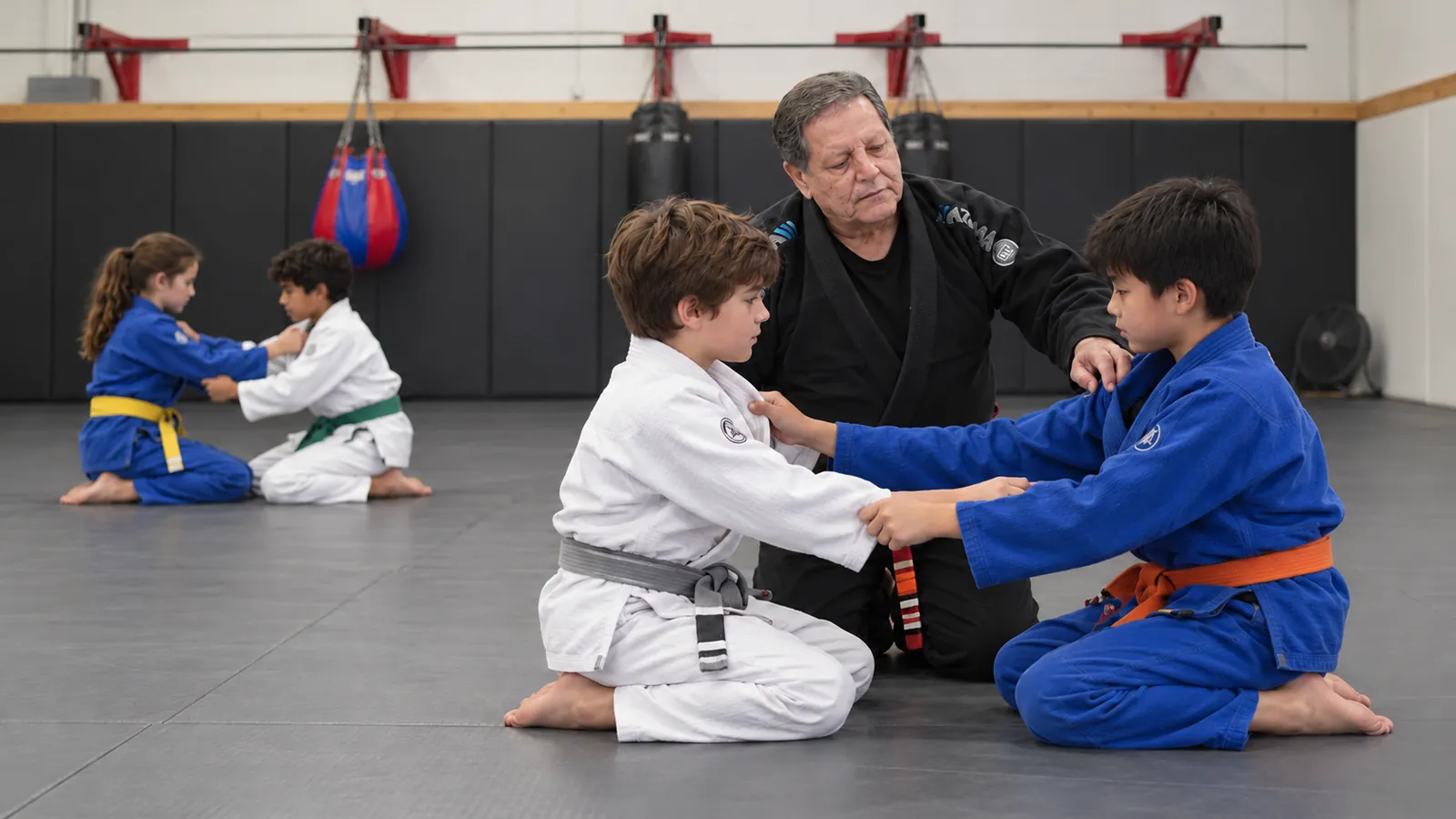
Starting later changes the arithmetic, not the rules. On our estimated range, someone who starts at 40 and trains steadily could expect to reach black belt somewhere between 48 and 52.
What comes after black belt?
Degrees. A black belt can earn six, marked on the belt's bar as they are awarded, and the IBJJF sets a minimum wait for each one:
| Degree | Minimum wait since the previous promotion | Minimum years as a black belt |
|---|---|---|
| 1st | 3 years | 3 |
| 2nd | 3 years | 6 |
| 3rd | 3 years | 9 |
| 4th | 5 years | 14 |
| 5th | 5 years | 19 |
| 6th | 5 years | 24 |
So a 2nd degree comes at least 6 years after black belt, and a 6th degree at least 24. Beyond that come the coral belts and then the red belt, ranks measured in decades. Marcus Soares is a 9th-degree red belt, the only one in Canada.
How many BJJ black belts are there in Canada?
There is no official national count. The IBJJF publishes a list of the black belts it has certified, searchable by name, degree and academy but not by country. When we checked in October 2026, it held more than 13,600 black belts worldwide.
Even that is not a census. The federation's own rules provide for black belts who have never registered with it, and rank in BJJ is awarded by a professor, so no single register captures everyone. What we can count is our own roll: 37 black belts promoted by Marcus Soares between 2004 and 2025, eleven of whom now lead affiliated academies in Canada, Mexico, the Netherlands and South Africa.
How do you get a black belt in BJJ?
One belt at a time, starting at white, with two or three classes a week that you can keep up for years, until your professor judges you ready. Complete beginners start in our Foundations class, taught at all three academies, and the $29 introductory two-week trial for new students is the simplest way to begin.
Common questions
By our estimate, 8 to 12 years for an adult who trains two or three times a week, and under Marcus Soares typically more than a decade. The IBJJF sets only minimums: its fastest standard route is four and a half years after leaving white belt, with at least 2 years at blue, 1.5 at purple and 1 at brown, and a minimum age of 19.
19, under the IBJJF's graduation system, which counts age by birth year. Since June 2026 the federation allows promotion at 18, but only for an athlete who has won the adult world title at brown belt. The adult coloured belts start at 16 for blue and purple and 18 for brown, so younger students train in a separate kids' belt system first.
Only just, on paper. The IBJJF's standard minimum times add up to four and a half years after leaving white belt, and that assumes a professor judges you ready the moment each one runs out. By our estimate, adults who train two or three times a week take 8 to 12 years, and more than a decade is typical under Marcus Soares.
Under the IBJJF's system, at least 3 years each for the 1st, 2nd and 3rd degrees, then 5 years each for the 4th, 5th and 6th. That puts a 2nd degree at least 6 years after black belt, a 3rd at 9 and a 6th at 24. The coral and red belts come after the 6th degree.
The academy's roll lists 37 black belts promoted by Marcus Soares between July 2004 and December 2025. The first, Denis Kang, came seven years and four months after Marcus began teaching in Canada in March 1997. The most recent were Nav Padda and Keenan Beavis, and the Langley Advance Times reported that Keenan's took 18 years.
There is no official national count. The IBJJF lists the black belts it has certified, more than 13,600 worldwide in October 2026, but the list is searched by name, degree and academy rather than country, and the federation's rules allow for black belts who have never registered with it. For reference, the academy's own roll lists 37 black belts promoted by Marcus Soares since 2004.
Want to try it on the mat?
Two weeks of unlimited classes for $29. No experience needed.
Sources
- International Brazilian Jiu-Jitsu Federation, General System of Graduation, June 2026
- International Brazilian Jiu-Jitsu Federation, Certified Black Belts
- Matthew Claxton, “Langley's 70-year-old jiu-jitsu grandmaster still teaches 7 days a week”, Langley Advance Times, May 2026
- Stephan Kesting, “Marcus Soares, the Encyclopedia of Brazilian Jiu-jitsu”, Grappling Magazine, August 2001 (republished on Grapplearts)
- Mark Raymundo, “5 Defining Moments: B.J. Penn”, Sherdog, December 2018